Introduction to Aerospace Test Software Project (Simulation Module Test Software) – Industrial Category
Release Date: June 8, 2022
This product is a high-precision simulation test system specially designed for aerospace mission computers! It is an essential tool for functional verification and performance testing after mission computer upgrades or modifications. It can highly restore real working scenarios of subsystems such as communication identification, electronic support, electro-optical targeting, and inertial navigation, accurately verifying the functional integrity, communication reliability, and logical correctness of the core mission processor. It provides full-process professional testing support for the safe, stable operation and efficient upgrading of aerospace equipment. The software adopts an optical fiber signal communication architecture, strictly adheres to dedicated codebook communication specifications, and integrates five core functional modules, each performing its own role while collaborating efficiently, covering module interaction, scenario simulation, and functional verification. It is the professional choice for aerospace equipment testing.
1. Overall Software Architecture and Module Interconnection Relationships
The software uses the core mission processor simulation module as the central control hub, coordinating the control handover, link loading, data fusion, autonomous decision-making authorization, and cooperative detection authorization modules. Through standard optical fiber interfaces and encrypted communication protocols, it achieves data exchange, command issuance, and process coordination. All modules are bidirectionally connected to the core module and coordinate on demand, forming a closed-loop testing logic of "core scheduling → module coordination → data feedback → functional verification". This fully aligns with the actual working mode of aerospace equipment and meets the requirements for high-precision and high-safety testing.
Core Collaboration Logic
The core simulation module provides unified command, issues instructions, receives feedback, and evaluates results; other functional modules simulate subsystem scenarios and upload test data according to instructions; the data fusion module coordinates with auxiliary simulation units to achieve multi-source data synergy; the entire process follows optical fiber communication and codebook specifications, ensuring data security, accurate transmission, and standardized procedures.
The simulation module test software adopts modular design and implementation, using multi-threaded programming technology to realize various functions, ensuring real-time performance and reliability of the program. The software architecture is shown in the figure below, and the specific functions implemented by each module will be introduced separately in the following sections.
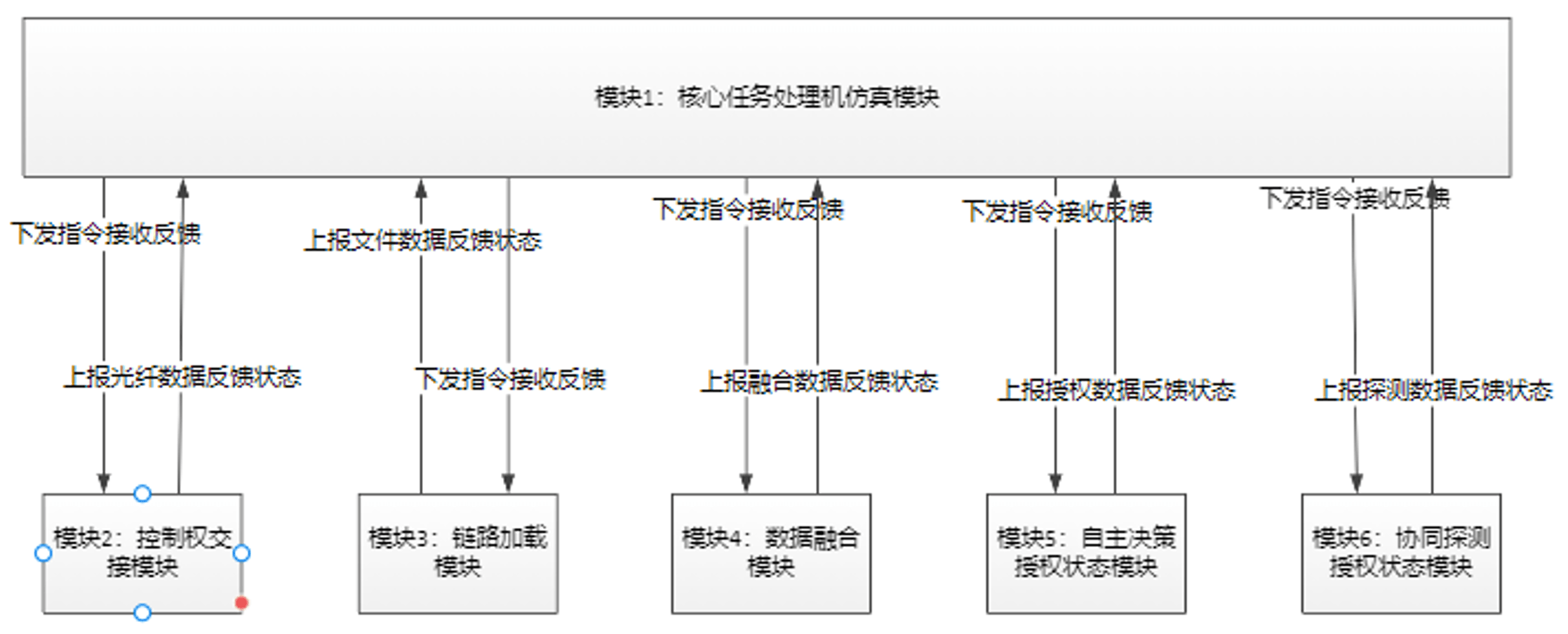
Note: In the flowchart, Module 1 is the core scheduling hub, responsible for coordinating the test process, parsing data, issuing commands, and simulating the working logic of a real core mission processor; Modules 2, 3, 4, and 5 are functional test modules, each corresponding to different test scenarios and directly exchanging data with Module 1; the Electronic Support Subsystem Simulation Unit and the Electro-Optical Targeting Subsystem Simulation Unit are auxiliary simulation units that work with the corresponding functional modules to complete scenario simulation, ensuring that the test scenarios are consistent with real equipment operating conditions.
2. Independent Functional Principles of Each Module
· Core Mission Processor Simulation Module (Central Control Center): Simulates the operation of the equipment’s core processor, receives test parameters, and generates test procedures; uniformly schedules each module, parses data, verifies results, and performs closed-loop control; supports test start/stop and parameter adjustment, adapts to various tests after upgrades and modifications, and complies with aerospace testing standards.
· Control Handover Module (Simulates Authority Switching): Simulates the control handover between the communication identification subsystem and the core processor; transmits optical fiber data in accordance with encrypted specifications, verifying whether the handover logic is correct; records interaction data throughout the process to ensure test traceability, achieving high consistency with real operating conditions.
· Link Loading Module (Simulates File Transfer): Simulates the loading and transfer of files such as routes and waypoints; securely and reliably uploads files, verifying the core processor's ability to receive, parse, and acknowledge; monitors the transfer status in real time to ensure complete and accurate file loading.
· Data Fusion Module (Simulates Multi-Source Information Aggregation): Interfaces with the electronic support and electro-optical targeting simulation units to collect target information; after verification and organization, reports the data to the core processor, validating the multi-source data fusion and decision-making capability; records the entire process data to facilitate troubleshooting and result verification.
· Autonomous Decision-Making/Cooperative Detection Authorization Module (Simulates Command Authorization): Simulates autonomous decision-making and cooperative detection authorization interactions; sends stimulus commands to verify the core processor's authorization judgment logic (allow/forbid); supports custom configuration and batch sending, covering multi-scenario authorization testing.
3. Core Value of the Software
This simulation test software is tailor-made for the upgrade and modification of aerospace mission computers. It features highly realistic scenario simulation, clear and efficient module collaboration, strictly compliant test procedures, and authentic and reliable results. It can comprehensively verify key capabilities such as control handover, link loading, data fusion, autonomous decision-making, and cooperative detection, significantly improving test efficiency, reducing test costs, and ensuring equipment safety. It provides solid and reliable testing support for the technological upgrade and stable iteration of aerospace equipment.








 Hybrid Technical Consulting
 Customizable Products
 Installation & Commissioning
 On-site Training and Guidance